🕊️ Ultimate Guide to Georgia’s 2026-2027 Dove Season
Dove season is one of Georgia’s most anticipated hunting traditions, and the 2026-2027 season is shaping up to be another exciting one. Opening day typically falls on the first Saturday in September, and for 2026, that means Saturday, September 5. Hunters across the Peach State will grab their shotguns, retrievers, and buckets for the unofficial kickoff to fall hunting.
Georgia runs a split statewide season with three segments stretching from early September through the end of January. The daily bag limit remains 15 birds, and hunters 16 and older need a valid Georgia hunting license along with a Georgia Waterfowl & Migratory Bird License. Dates, bag limits, and field conditions are set within federal migratory bird frameworks established by the U.S. Fish & Wildlife Service and adopted annually by the Georgia DNR Wildlife Resources Division.
Whether you’re hunting a private sunflower field in South Georgia or drawing a quota permit for Di-Lane Plantation WMA, this guide covers everything you need to know — from season dates and license requirements to the best public dove fields and species identification tips.
⚡ Quick Answer
Georgia Dove Season 2026-2027 is expected to open Saturday, September 5, 2026, and run in three split segments: September 5–October 11, November 21–29, and December 19–January 31, 2027. The season is statewide (no zones). The daily bag limit is 15 doves with a possession limit of 45. Legal shooting hours run from one-half hour before sunrise to sunset. Hunters 16+ need a Georgia hunting license and a Georgia Waterfowl & Migratory Bird License (which includes HIP registration). Eurasian collared doves may be taken at any time with no bag limit.
📊 Georgia Dove Season 2026-2027 Overview
Georgia’s dove season is set within the federal migratory bird hunting framework established by the U.S. Fish & Wildlife Service. Each year, the Georgia DNR Wildlife Resources Division selects season dates and bag limits that fit within those federal guidelines.
Here’s a quick snapshot of what to expect:
| Species | Season | Zone | Opening Date | Closing Date | Daily Bag Limit | Possession Limit | Status |
|---|---|---|---|---|---|---|---|
| Mourning Dove | Split (3 segments) | Statewide | Sept. 5, 2026 | Jan. 31, 2027 | 15 | 45 | Pending Official Announcement |
| White-winged Dove | Split (3 segments) | Statewide | Sept. 5, 2026 | Jan. 31, 2027 | 15 (combined with mourning) | 45 | Pending Official Announcement |
| Eurasian Collared Dove | Year-round | Statewide | No closed season | No closed season | No limit | No limit | Open |
The three-split structure gives hunters a strong early September opener, a short Thanksgiving-week segment, and a long winter segment that runs through the end of January. This format has been consistent for several consecutive seasons and is expected to hold for 2026-2027.
📅 Official Dove Season Dates
Georgia’s dove season follows a three-segment split structure statewide. Based on the latest available information and established patterns, the projected dates for 2026-2027 are:
- First Segment: September 5 – October 11, 2026
- Second Segment: November 21 – 29, 2026
- Third Segment: December 19, 2026 – January 31, 2027
These dates align with the season structure Georgia has used for multiple consecutive years, shifting by a day or two each year based on the calendar. For reference, the 2025-2026 season ran September 6–October 12, November 22–30, and December 19–January 31 — confirming the consistent framework.
Mourning Dove
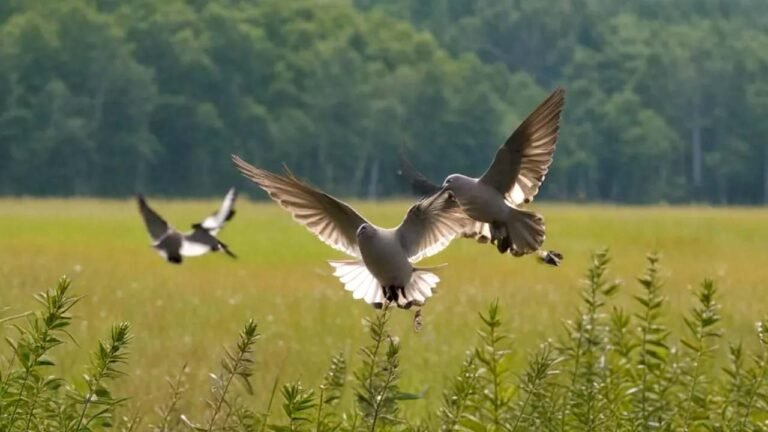
The mourning dove is the primary species Georgia hunters pursue. It’s included in all three split segments with a daily bag limit of 15 and a possession limit of 45. These birds are found throughout the state in agricultural areas, field edges, and around water sources.
White-winged Dove
White-winged doves are less common in Georgia than mourning doves but can occasionally be found, particularly in the southern part of the state. They count toward the same 15-bird daily bag limit as mourning doves. Identification is important since white-winged doves are larger and have a distinctive white wing patch.
Eurasian Collared Dove
Eurasian collared doves are an invasive, non-native species. Georgia regulations allow them to be taken at any time with no bag limit. They’re larger than mourning doves with a black half-collar on the back of the neck. Since they don’t count toward your daily limit, hunters are encouraged to harvest them freely.
Always verify the final official dates in the 2026-2027 Georgia Hunting Regulations before planning your hunt.
🗺️ Dove Hunting Zones in Georgia
Here’s something that sets Georgia apart from many other dove hunting states: Georgia does not use dove hunting zones. The season is statewide, meaning the same opening day, closing day, and bag limits apply whether you’re hunting in the North Georgia mountains or the coastal plains near Savannah.
This simplifies planning considerably. You don’t have to worry about which zone you’re in or memorize different date sets for different regions. One season, one set of rules, the entire state.
That said, Georgia DNR organizes its Wildlife Management Areas into six administrative regions for management purposes:
- Region 1 — Northwest Georgia
- Region 2 — North Georgia
- Region 3 — East Central Georgia
- Region 4 — Southeast Georgia
- Region 5 — Southwest Georgia
- Region 6 — Coastal Georgia
While these regions aren’t hunting zones, they help you locate nearby public dove fields and connect with the right regional game management office for field condition updates.
🎯 Daily Bag Limits
| Species | Daily Limit | Possession Limit | Special Rules |
|---|---|---|---|
| Mourning Dove | 15 | 45 | Counts toward combined dove limit |
| White-winged Dove | 15 (combined with mourning) | 45 | Included in the same daily bag |
| Eurasian Collared Dove | No limit | No limit | May be taken year-round, does not count toward daily bag |
| Common Ground Dove | Not legal to harvest | — | Protected; learn to distinguish from mourning dove |
The possession limit is set at three times the daily bag limit, which means you can legally possess up to 45 doves at one time. If you’re hunting multiple days, remember that the possession limit applies to birds in your freezer, cooler, or anywhere else under your control.
⏰ Legal Hunting Hours
Georgia’s dove hunting hours are straightforward:
- Start: One-half hour before sunrise
- End: Sunset
These hours apply statewide and across all three season segments. There are no special opening-day exceptions in Georgia — the half-hour-before-sunrise start time applies on day one just as it does throughout the season.
Federal migratory bird regulations also govern shooting hours, and Georgia’s rules align with those frameworks. Always check the exact sunrise and sunset times for your hunting location, as they vary across the state. A hunt near Dalton in North Georgia will have slightly different light conditions than one near Valdosta in South Georgia.
Pro tip: The best shooting usually happens during the first two hours after sunrise and the last hour before sunset, when doves are actively moving between roosting, feeding, and watering areas.
🪪 Licenses Needed
Georgia has streamlined its migratory bird licensing system. Here’s what you need for the 2026-2027 dove season:
Georgia Hunting License
Every hunter 16 years of age and older must possess a valid Georgia hunting license. Resident and nonresident options are available.
Georgia Waterfowl & Migratory Bird License
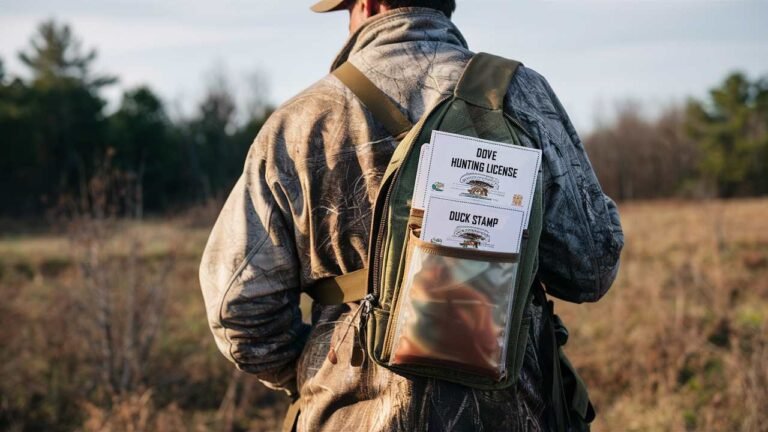
This is the key license for dove hunters. Georgia combined the old HIP (Harvest Information Program) license and the Waterfowl Conservation License into a single Georgia Waterfowl & Migratory Bird License. It’s required for all hunters 16 and older who pursue doves, ducks, geese, woodcock, snipe, coots, rails, or gallinules. This license serves as your HIP registration.
License Price Summary
| License Type | Resident | Nonresident |
|---|---|---|
| Annual Hunting License | ~$11 | ~$151 |
| Waterfowl & Migratory Bird License | ~$11 | ~$11 |
| 1-Day Hunting License | ~$8 | ~$21 |
| Sportsman’s License (includes hunting + migratory bird) | ~$65 | N/A |
| Lifetime Sportsman’s License | Varies by age | N/A |
Prices are approximate and subject to change. Confirm current fees at GoOutdoorsGeorgia.com.
Exemptions
- Resident Landowners: Hunting on their own land get a free Georgia Waterfowl & Migratory Bird License. They still need a hunting license unless otherwise exempt.
- Youth (under 16): Not required to purchase a hunting license or migratory bird license. The youth definition was updated to include persons under 16 years of age.
- Senior Residents (65+): May qualify for a free honorary license, which includes migratory bird privileges.
- Disabled Veterans & Disability License Holders: Eligible for free or reduced-cost licenses, including migratory bird privileges.
- Active Duty Military: Georgia residents on full-time military duty stationed in Georgia may hunt with a resident license. Nonresidents stationed in Georgia may purchase resident licenses.
- Sportsman’s License Holders: The Georgia Waterfowl & Migratory Bird License is included at no additional cost.
Federal Duck Stamp
A Federal Duck Stamp is not required for dove hunting. It’s only required for waterfowl hunters 16 and older. However, if you plan to chase ducks later in the season, the electronic Duck Stamp is now valid immediately upon purchase through GoOutdoorsGeorgia.com.
🔫 Legal Hunting Methods
Shotguns
Dove hunting in Georgia is shotgun-only. Here are the key requirements:
- Gauge: 10-gauge or smaller
- Plug requirement: Shotguns must be plugged to hold no more than three shells total (one in the chamber, two in the magazine)
- Nontoxic shot: Not required for dove hunting. Lead shot is legal for doves. (Nontoxic shot is only required for waterfowl.)
Retrievers and Dogs
Dogs are legal and highly effective for dove hunting. A well-trained retriever can save you time and reduce wounded bird loss, especially in tall crop cover. There are no restrictions on using dogs for dove retrieval.
Decoys
Decoys are legal and can be effective, particularly during the late season segments when doves are more scattered. Stationary dove decoys placed on fences, dead trees, or floaters in water holes can attract passing birds.
Electronic Calls
Electronic or recorded calls are prohibited for dove hunting in Georgia. This falls under federal migratory bird regulations, which prohibit the use of electronic calls for doves. You must rely on natural field positioning and decoys.
Baiting Laws
Baiting is strictly regulated. You cannot hunt doves over baited fields where grain, salt, or other attractants have been distributed to concentrate birds. However, you can hunt over fields where crops have been planted and manipulated through normal agricultural practices. Georgia DNR publishes a helpful brochure called “Dove Hunting and Agricultural Practices in Georgia” that explains what’s legal and what isn’t.
Key baiting rules:
- Hunting over freshly planted or manipulated crops from normal agriculture is legal
- Hunting over grain scattered by mechanical harvest or other means not related to normal farming is illegal
- Fields must be planted for a legitimate agricultural purpose
- Top-sown grain is considered bait
Motor Vehicle Restrictions
It is illegal to shoot from a motor vehicle, including ATVs. You must dismount to shoot. Additionally, hunting from public roads or shooting across public road right-of-ways is prohibited.
📍 Best Places to Hunt Doves in Georgia
Georgia offers excellent public dove hunting opportunities through a network of Wildlife Management Areas (WMAs), Public Fishing Areas (PFAs), and Voluntary Public Access (VPA) properties. The Georgia DNR manages dozens of planted dove fields statewide, with crops including sunflowers, browntop millet, wheat, sorghum, and proso millet.
Quota Dove Hunts
For the 2026-2027 season, Georgia DNR is offering 21 quota hunts across 17 WMAs, VPAs, and PFAs, including 18 Opening Day hunts on September 5 and three follow-up hunts on September 12. That’s a total of approximately 1,270 hunter slots available.
Applications open through the Go Outdoors Georgia system, with a deadline of August 15. These quota hunts are competitive — last year’s drawing attracted over 6,400 first-choice applications. Some premier fields like Di-Lane WMA, Perry Dove Field, and Clybel WMA draw the most attention, but many less-publicized locations offer excellent hunting with better draw odds.
Top Public Dove Fields by Region
Region 1 — Northwest Georgia:
- Joe Kurz WMA (190 acres of mixed crops — one of the largest public fields in the state)
- Crockford-Pigeon Mountain WMA (sunflowers, corn, and millet)
- West Point WMA (wheat and sunflowers near the Alabama border)
Region 2 — North Georgia:
- Redlands WMA (50 acres of millet and sunflowers)
- Dawson Forest WMA (diverse crop plantings near the North Georgia mountains)
Region 3 — East Central Georgia:
- Di-Lane Plantation WMA (130 acres — one of the most popular quota hunts in the state)
- Clybel WMA (135 acres of wheat, sorghum, and sunflowers)
- Perry Dove Field (consistently high demand — apply early)
- Cedar Creek WMA (47 acres with diverse plantings)
Region 4 — Southeast Georgia:
- Hiltonia WMA (browntop millet — rated Good)
- Ocmulgee WMA / Gum Swamp WMA
Region 5 — Southwest Georgia:
- Chattahoochee Fall Line WMA – Hilliard (213 acres — the largest public dove field in the state)
- Elmodel WMA (176 acres of millet and wheat)
- Chickasawhatchee WMA (millet and Egyptian wheat)
Region 6 — Coastal Georgia:
- Richmond Hill WMA (proso and browntop millets — rated Good)
- Townsend WMA (57 acres of browntop millet)
- Altamaha WMA
Non-Quota Public Fields
If you don’t draw a quota permit, don’t worry. Georgia also maintains numerous non-quota public dove fields where hunters simply show up on opening day, find an available spot, and hunt. Check the annual Dove Field Forecast at GeorgiaWildlife.com for field conditions and availability.
For more details on Georgia’s public dove hunting opportunities, check out our comprehensive Georgia Dove Hunting Season guide.
💡 Top Dove Hunting Tips
Here are 15 Georgia-specific tips to help you have a successful 2026-2027 dove season:
- Scout fields before opening day. Drive by potential hunting spots a few days before September 5 to confirm dove activity. If birds aren’t using a field midweek, they likely won’t be there Saturday.
- Apply for quota hunts strategically. Review the previous year’s draw odds before applying. Premier fields like Di-Lane and Perry require 3-4 priority points, but 11 of Georgia’s 21 quota hunts can be drawn with just 1-2 points.
- Hunt the edges. Doves love transitions — where crop fields meet fence lines, tree lines, or power lines. Set up where birds naturally funnel.
- Find the water source. Doves drink daily, often mid-morning and late afternoon. A stock pond or creek near a feeding field can be a goldmine during the second and third season segments.
- Use the Dove Field Forecast. Georgia DNR publishes field condition ratings (Excellent, Good, Fair, Poor) before each season. Use it to pick the most promising public fields.
- Practice your lead. Doves fly 40-55 mph. Most hunters shoot behind them. Practice on clay targets before the season to calibrate your swing speed.
- Bring a retriever. Georgia dove fields often have tall millet and wheat stubble that hides downed birds. A good dog saves time and reduces lost birds.
- Wear blaze orange or blaze pink. Georgia now allows either fluorescent orange or fluorescent pink (at least 500 square inches). Safety first on crowded public fields.
- Hunt the second segment. The Thanksgiving-week segment (November 21-29) sees far fewer hunters and often has fresh migratory birds moving through. It can be some of the best shooting of the year.
- Watch for Eurasian collared doves. They’re larger, slower, and don’t count toward your 15-bird limit. Harvest them freely to help manage this invasive species.
- Check grain field cuttings. After the first segment, recently harvested corn and soybean fields become dove magnets. Scout agricultural areas for fresh cuttings during the winter segment.
- Arrive early on public fields. Non-quota fields fill up fast on opening day. Arrive at least an hour before shooting time to claim a good position along a fence line or tree edge.
- Pack plenty of water. Early September in Georgia means temperatures in the 80s and 90s. Bring more water than you think you’ll need, especially if you’re running a dog.
- Take the Dove Harvest Survey. If you hunt a public dove field, Georgia DNR asks hunters to complete a harvest survey. Your feedback helps manage future seasons and field allocations.
- Report banded doves. Georgia participates in the federal dove banding program. Check harvested birds for leg bands and report them at reportband.gov. It’s a contribution to conservation science.
📢 Recent Regulation Changes for 2026-2027
Georgia has implemented several regulatory updates that dove hunters should be aware of for the 2026-2027 season:
- New Migratory Bird License Structure: The old HIP license and Waterfowl Conservation License have been combined into the single Georgia Waterfowl & Migratory Bird License. This streamlines the purchasing process and covers all migratory bird hunting, including doves.
- Youth Definition Updated: Youth is now defined as persons under 16 years of age, aligning with federal youth hunting provisions.
- Blaze Pink Authorized: Hunters may now wear either fluorescent pink or fluorescent orange (at least 500 square inches) during Georgia hunting seasons, thanks to HB 167.
- Electronic Duck Stamps: The Duck Stamp Modernization Act of 2023 made electronic Duck Stamps valid immediately upon purchase through GoOutdoorsGeorgia.com. While this doesn’t affect dove hunters directly, it simplifies licensing for those who also pursue waterfowl.
- Deer Carcass Disposal Rules: New CWD-related carcass disposal requirements mandate on-site disposal of inedible deer parts. While not directly related to dove hunting, this is important if you hunt multiple species.
Overall, dove hunting regulations themselves remain substantially unchanged for 2026-2027. The 15-bird daily limit, three-shell plug requirement, and statewide season structure carry forward from previous years.
🦺 Hunter Safety Tips
Dove hunting is generally low-risk compared to big game hunting, but safety should never be overlooked — especially on crowded public fields.
Firearm Safety
- Always treat every firearm as if it’s loaded
- Keep your muzzle pointed in a safe direction at all times
- Be aware of other hunters’ positions, especially on public fields where spacing can be tight
- Never shoot at low-flying birds — a skyward shot with a clear backdrop is the only safe angle
- Unload your shotgun when moving between locations or crossing fences
Heat Safety
September in Georgia is hot. Heat exhaustion and dehydration are real risks on opening day.
- Drink water continuously throughout the hunt
- Take breaks in the shade during the midday lull
- Wear lightweight, breathable clothing under your blaze orange/pink
- Watch your dog for signs of overheating — dogs overheat faster than humans
Dog Safety
- Carry extra water for your retriever
- Check your dog for snakes before and after hunts — cottonmouths and rattlesnakes are active in September
- Take frequent rest breaks, especially in the first segment heat
- Inspect your dog’s paws for cuts from stubble and crop stubble
Eye and Hearing Protection
- Wear shooting glasses to protect your eyes from falling shot, debris, and spent hulls
- Use hearing protection — repeated shotgun blasts cause cumulative hearing damage over seasons
Bird Identification
- Learn to distinguish mourning doves from protected common ground doves
- Identify white-winged doves and Eurasian collared doves correctly
- When in doubt, let the bird pass — there’s no penalty for passing on an uncertain shot
Ethical Hunting
- Only shoot within your effective range — most dove shots should be within 30-40 yards
- Make every effort to retrieve downed birds
- Respect other hunters’ space and don’t sky-bust birds that are out of range
- Follow all field rules on WMAs and public dove fields
🕊️ Common Dove Species Found in Georgia
Mourning Dove
Identification: Slim, grayish-brown body with a long pointed tail. Black spots on the wings and a soft, mournful “coo-ah-coo-coo-coo” call. Approximately 11-13 inches long.
Habitat: Found statewide in agricultural areas, field edges, fence lines, and near water sources. The most abundant and widely distributed dove species in Georgia.
Migration: Georgia has both resident breeding birds and migratory birds from northern states. Northern migrants begin arriving in late September and October, boosting bird numbers during the second and third season segments.
Best Hunting Strategy: Set up along flight paths between roosting areas and feeding fields. Sunflower and millet fields are top producers. Morning and evening flights are most productive.
White-winged Dove
Identification: Larger than the mourning dove with a distinctive white wing patch visible in flight. Gray-brown body with a square-tipped tail. About 11-12 inches long.
Habitat: More common in South Georgia, particularly near agricultural areas. Less abundant than mourning doves but increasingly observed in recent years.
Migration: Some white-winged doves are expanding their range eastward from the Southwest. They’re most likely encountered in the southern part of the state.
Best Hunting Strategy: Same approach as mourning doves — position near feeding fields and water sources. Count them toward your 15-bird daily limit.
Eurasian Collared Dove
Identification: Larger than a mourning dove with a sandy gray-brown body and a distinctive black half-collar on the back of the neck. Square-tipped tail. About 12-13 inches long.
Habitat: Often found near human habitation — farmyards, grain elevators, suburban areas. Expanding throughout Georgia.
Migration: Non-migratory. These birds are year-round residents and an invasive species.
Best Hunting Strategy: Target them near farm structures and feed lots. No bag limit and no closed season — harvest freely to help manage the invasive population.
❓ Frequently Asked Questions
When does Georgia dove season open in 2026?
Georgia dove season is expected to open on Saturday, September 5, 2026. The season runs in three split segments through January 31, 2027. Verify the final official dates in the published 2026-2027 Georgia Hunting Regulations before your hunt.
What is the daily bag limit for doves in Georgia?
The daily bag limit is 15 doves (mourning and white-winged combined). The possession limit is 45 doves. Eurasian collared doves do not count toward this limit and may be taken year-round with no restriction.
Do I need a HIP license to hunt doves in Georgia?
Yes. Georgia now uses the Georgia Waterfowl & Migratory Bird License, which combines the former HIP license and waterfowl license into one. It’s required for all hunters 16 and older pursuing doves or any other migratory bird. You can purchase it at GoOutdoorsGeorgia.com.
What are the legal shooting hours for dove hunting in Georgia?
Legal shooting hours are from one-half hour before sunrise to sunset statewide. These hours apply on opening day and throughout all three season segments. There are no special opening-day exceptions.
Does Georgia have different dove hunting zones?
No. Georgia’s dove season is statewide — there are no separate zones, and the same dates and bag limits apply everywhere in the state. This simplifies planning compared to states with zone-based seasons.
Can I hunt doves over baited fields in Georgia?
No. Hunting over baited fields is illegal under both state and federal law. However, you can legally hunt over fields where crops have been planted and managed through normal agricultural practices. Georgia DNR’s brochure “Dove Hunting and Agricultural Practices in Georgia” explains the distinction in detail.
Can I use lead shot for dove hunting in Georgia?
Yes. Lead shot is legal for dove hunting in Georgia. Nontoxic shot requirements apply only to waterfowl hunting. However, many hunters are transitioning to steel or bismuth shot for environmental reasons.
How do I apply for Georgia WMA dove quota hunts?
Apply through the Go Outdoors Georgia system at GoOutdoorsGeorgia.com. The application deadline is August 15. Georgia offers 21 quota hunts across 17 WMAs, VPAs, and PFAs for the 2026-2027 season, with approximately 1,270 hunter slots available.
Can youth hunters participate in dove hunting without a license?
Yes. Hunters under 16 years of age are not required to purchase a hunting license or migratory bird license in Georgia. Youth dove hunts are also available through the quota system, providing excellent opportunities to introduce young hunters to the sport.
Are Eurasian collared doves legal to hunt in Georgia?
Yes. Eurasian collared doves may be taken at any time with no bag limit. They’re an invasive, non-native species, and hunters are encouraged to harvest them freely. They do not count toward your 15-bird daily mourning dove limit.
🏁 Final Thoughts
The Georgia dove season 2026-2027 promises to deliver everything hunters love about this tradition — early September warmth, fast-flying birds, well-managed public fields, and the camaraderie that makes dove hunting such a social sport. With a statewide three-segment season running from September 5 through January 31, a 15-bird daily limit, and over 50 public dove fields across six regions, Georgia remains one of the Southeast’s premier dove hunting destinations.
Remember to secure your Georgia hunting license and Waterfowl & Migratory Bird License well before opening day. If you’re targeting a quota hunt, get your application in by August 15. And whether you’re hunting private land or a WMA, always verify the final season dates and regulations with Georgia DNR before you pull the trigger.
Dove season is more than a hunt — it’s the kickoff to Georgia’s entire fall hunting calendar. So grab your shotgun, pack plenty of shells and water, and make this the year you fill your limit on opening day. For more on neighboring opportunities, check out our South Carolina Dove Season guide or the official Georgia DNR Migratory Bird Seasons page.
Happy hunting, and stay safe out there. 🕊️